
No — security cameras don’t always require professional installation. A single Wi-Fi camera or a video doorbell is a legitimate DIY project. Professional installation becomes the right call when you have multiple cameras, need cable runs through walls or masonry, want reliable 24/7 recording on an NVR, or plan to use Philadelphia’s reimbursement program — which requires a licensed contractor’s estimate.
As installers, we could tell you DIY never works. That would be false. Here’s the honest breakdown of where each approach wins.
The Comparison Table
| Factor | DIY | Professional |
|---|---|---|
| Upfront cost | Equipment only ($50–$300/camera) | Equipment + labor (from $1,300 for a 4-camera system) |
| Camera types | Mostly Wi-Fi, battery, doorbell | Wired PoE/IP, 6MP–8MP, NVR-based |
| Reliability | Depends on Wi-Fi strength and battery charge | Wired power and data — no dead batteries, no dropped streams |
| Recording | Cloud clips, often subscription-based | Continuous local NVR recording, no mandatory fees |
| Coverage planning | Trial and error | Site survey: entry points mapped before mounting |
| Masonry / brick walls | Hard: drilling, anchoring, weatherproofing on your own | Included; conduit quoted upfront |
| Warranty | Equipment only; installation issues are on you | Equipment + workmanship warranty |
| BSCP eligibility (Philadelphia) | No — the program requires a licensed contractor estimate | Yes — licensed and insured, BSCP-ready paperwork |
| Insurance documentation | Rarely accepted | Itemized system spec for your insurer |
When DIY Is a Perfectly Good Choice
- One or two cameras watching a door or a register area.
- A video doorbell — designed for self-install by every major brand.
- Renters who can’t drill and need removable equipment.
- Testing the waters before committing to a full system.
If that’s your situation, buy a reputable brand, put cameras high enough to avoid tampering, and check your footage weekly. No shame in it — and when you outgrow the setup, the placement lessons transfer.
When Professional Installation Is Worth the Money
Four or more cameras. Coverage planning stops being intuitive: overlapping fields of view, blind spots behind signage, lens choice for distance. A site survey solves in an hour what trial-and-error solves in a month.
Brick and masonry buildings. Most Philadelphia commercial buildings are exactly that. Drilling brick, running weatherproof conduit, and sealing penetrations is where DIY projects stall — or leak.
Continuous recording requirements. Wi-Fi cameras record motion clips to the cloud. If an incident review, an insurance claim, or a police footage request needs the full timeline (SafeCam requests work through you), you want an NVR recording 24/7 — sized, configured, and tested.
Business compliance and insurance. Insurers, landlords, and compliance frameworks want documented, professionally specified systems. A shoebox of Wi-Fi cameras doesn’t produce an itemized spec.
Philadelphia’s Business Security Camera Program. This one is decisive for city businesses: BSCP reimburses up to 75% of exterior camera costs (up to 100% in targeted corridors), but the application requires at least one estimate from a licensed contractor — and corridor applicants must use a contractor from the City’s approved list. A DIY install simply isn’t eligible. Full BSCP guide.
Run the numbers before assuming DIY is cheaper: a $1,620 professionally installed 4-camera system minus 75% reimbursement is $405 out of pocket — less than four mid-range Wi-Fi cameras at retail. Full pricing breakdown.
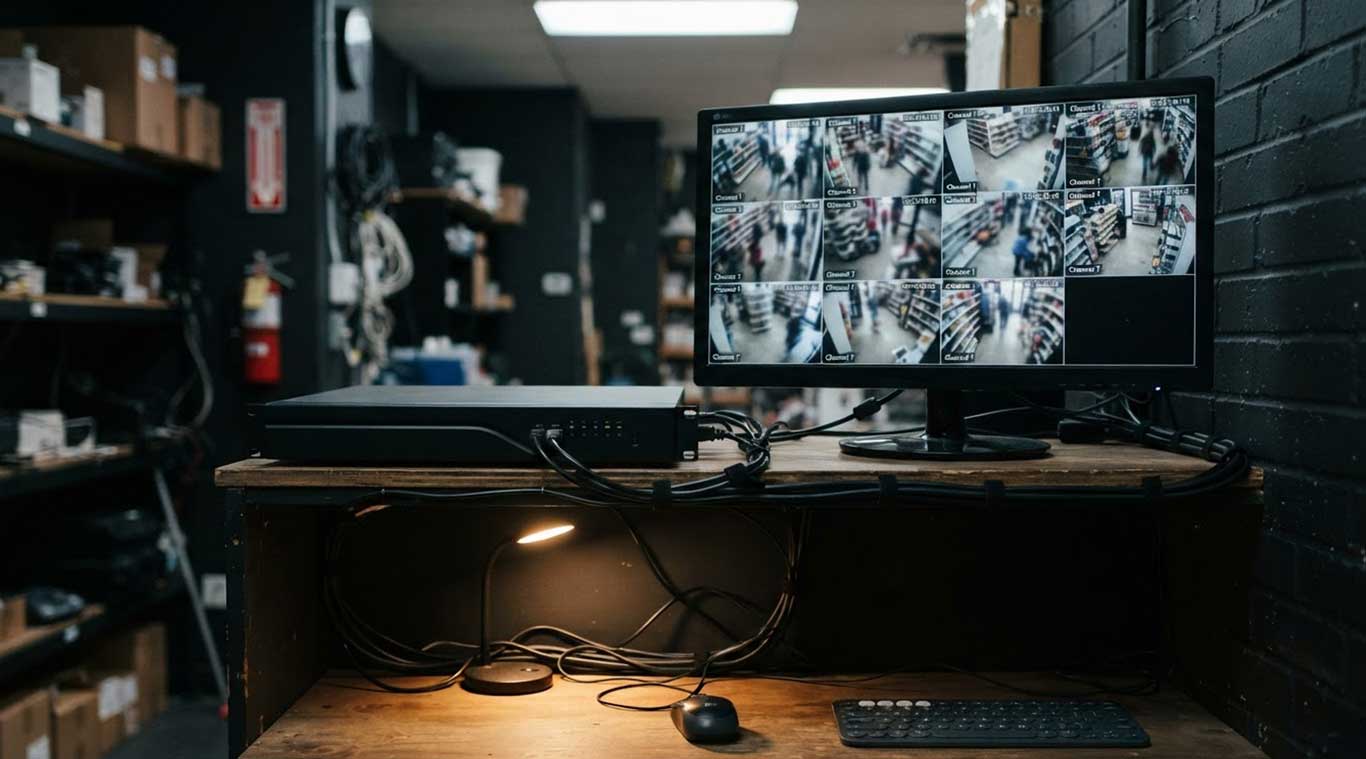
What Professional Installation Actually Includes
Worth knowing what you’re paying for — and what to demand from any installer:
- Site survey — entry points, sight lines, lighting conditions, mounting positions mapped before anything is ordered.
- System design — camera models and lenses matched to each position, NVR and storage sized to your retention needs.
- Clean installation — concealed cable runs, weatherproofed penetrations, tamper-resistant mounting height.
- Configuration — recording schedules, motion zones, remote viewing on your devices, tested before handover.
- Walkthrough and warranty — you learn to pull footage; workmanship is covered in writing.
See our commercial installation process.
The Middle Path: Hybrid
A fair option many guides skip: professionally installed core system (exterior wired cameras + NVR) with DIY extras added later — an interior Wi-Fi camera in a stockroom, a doorbell unit. The wired backbone does the serious work; the extras add convenience. We design systems with this expansion in mind.
FAQ
Can I install security cameras myself legally?
Yes. There’s no license requirement for installing cameras on your own property. Licensing matters when you hire someone (verify their PA contractor credentials) — and when you apply for Philadelphia’s reimbursement program, which requires licensed contractor estimates.
Will DIY cameras lower my insurance premium?
Sometimes, but insurers typically give better consideration to documented, professionally installed systems with continuous recording. Ask your broker what documentation they need — then match the installation to it.
How long does professional installation take?
Most Philadelphia commercial installations of 4–8 cameras are completed in a single day, typically within 24–48 hours of quote approval.
Do wired cameras really beat Wi-Fi cameras?
For business use, almost always: no battery maintenance, no bandwidth-dependent quality drops, continuous recording, and better resolution per dollar. Wi-Fi cameras win on installation speed and flexibility — which is why they’re fine for supplementary coverage.
What happens if I DIY now and want to go professional later?
Nothing is wasted except some time: mounting positions you validated stay useful, and some equipment can serve as secondary coverage. We regularly upgrade DIY setups to wired systems — the survey tells you what’s reusable.
Not sure which side of the table you’re on? Book a free site survey — we’ll tell you honestly if your project is a DIY job. Or price a professional system first.